Income-Driven Repayment Plans in the USA Explained: Lower Student Loan Payments the Smart Way
Income-Driven Repayment Plans in the USA Explained: Lower Student Loan Payments the Smart Way
Learn how Income-Driven Repayment (IDR) plans work in the USA. Compare SAVE, PAYE, and IBR, reduce monthly payments, understand forgiveness, and avoid common mistakes.




“Working adult checking income-driven student loan payment online in the USA”
“Couple budgeting to reduce student loan EMI at home”
“Graduate paying student loan through mobile banking in America”
“Student loan repayment planning with calculator and bills”
“Family discussing income-driven repayment options in the USA”
For many Americans, student loan payments feel like a second rent bill.
Every month, hundreds of dollars go out before savings, vacations, or family plans. That’s why millions of borrowers turn to Income-Driven Repayment (IDR) plans.
These plans can legally reduce your monthly payment — sometimes to $0 — while keeping you in good standing.
In this guide, you’ll learn:
What IDR plans are
How SAVE, PAYE, and IBR work
Who should use them
Real examples and charts
How forgiveness fits in
Common mistakes to avoid
Let’s explain everything in simple words.
Who Manages Income-Driven Repayment in the USA?
Most federal student loans are overseen by the
U.S. Department of Education
through its official portal:
Federal Student Aid (studentaid.gov)
Consumer protections and guidance are also provided by the
Consumer Financial Protection Bureau.
👉 IDR plans apply only to federal student loans, not private loans.
What Is an Income-Driven Repayment (IDR) Plan?
In simple terms:
Your monthly payment is based on your income — not on how much you borrowed.
Instead of paying a fixed amount, you pay a percentage of your “discretionary income.”
If your income is low, your payment is low.
If your income rises, your payment rises slowly.
This makes IDR plans ideal for:
✔ Entry-level workers
✔ Teachers, nurses, social workers
✔ Parents with dependents
✔ Freelancers
✔ People in career transition
Main Income-Driven Repayment Plans
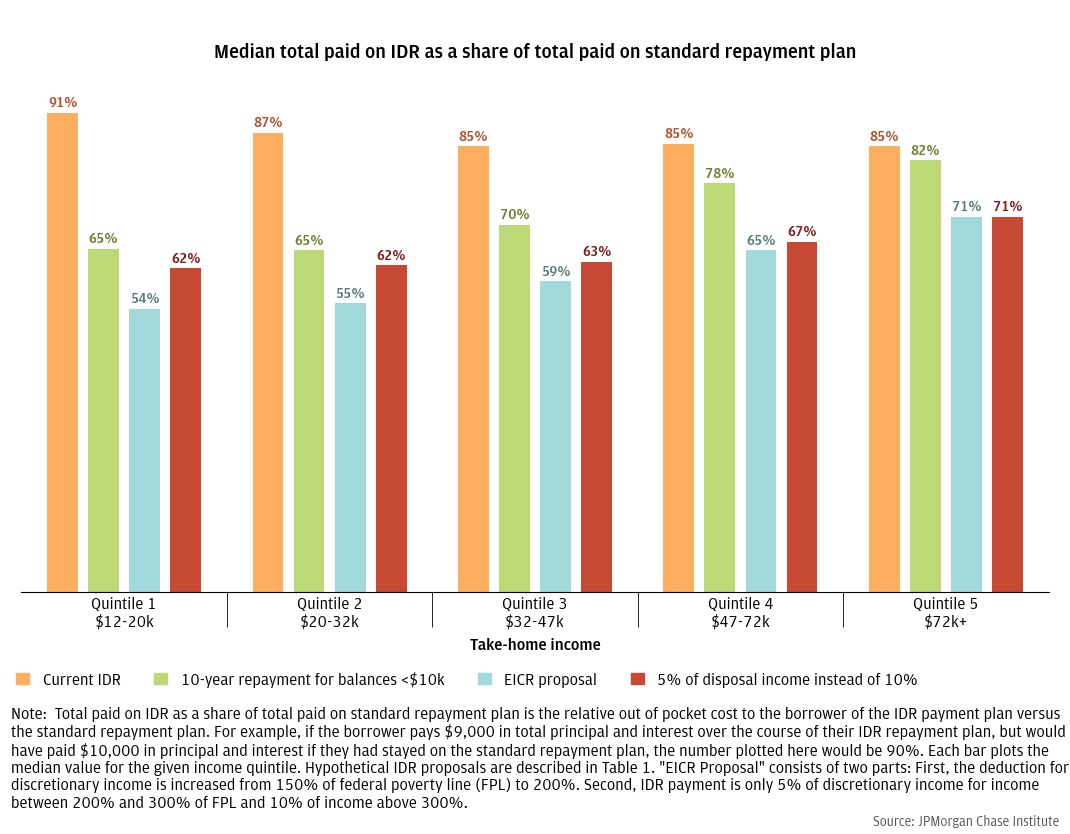



Current Major IDR Options
| Plan | Payment Rate | Forgiveness | Best For |
|---|---|---|---|
| SAVE | ~5% of income | 20–25 yrs | Most borrowers |
| PAYE | ~10% | 20 yrs | Moderate earners |
| IBR | 10–15% | 20–25 yrs | Older loans |
(Source: Investopedia)
Note: Program rules can change. Always check studentaid.gov for current enrollment status.
How IDR Calculates Your Payment (Easy Formula)
IDR uses this basic idea:
Discretionary Income =
Annual Income – 150% of Poverty Line

Monthly Payment =
(Discretionary Income × Plan %) ÷ 12
Example Calculation
Kevin lives in Ohio.
Income: $45,000
Family size: 1
Poverty line (approx.): $15,000
150% level: $22,500
Discretionary income:
$45,000 – $22,500 = $22,500
On SAVE plan (5%):
$22,500 × 5% = $1,125/year
= $94/month
👉 His standard plan was $390.
Now he pays $94.
Why the SAVE Plan Is So Popular
SAVE is currently the most borrower-friendly IDR plan.
Key Benefits
✔ Lower percentage (5%)
✔ Higher income protection
✔ Interest subsidy in many cases
✔ $0 payments for very low income
Example
Maria earns $32,000.
Under SAVE:
Her calculated payment = $0
Interest does not grow fast.
She stays in good standing without defaulting.
Income-Driven Repayment vs Standard Plan (Chart)
Example: $35,000 Federal Loan at 6%
| Plan | Monthly Payment | Total Cost |
|---|---|---|
| Standard (10 yrs) | $390 | $46,800 |
| IDR (SAVE) | $140 | Depends on income |
| IDR + Forgiveness | $140 → $0 | Often lower |
IDR improves cash flow, even if total cost may rise.
IDR and Loan Forgiveness: How They Connect
One big benefit of IDR is long-term forgiveness.
How It Works
If you:
✔ Stay on IDR
✔ Make qualifying payments
✔ Recertify yearly
Then after:
20 years (some plans)
25 years (others)
Remaining balance may be forgiven.
Tax Rule
Forgiven amounts may sometimes be taxable.
Check rules with
Internal Revenue Service.
IDR + Public Service Loan Forgiveness (PSLF)
If you work in:
✔ Government
✔ Public schools
✔ Nonprofits
✔ Public hospitals
You can combine IDR + PSLF.
Result
Pay under IDR
Work 10 years
Balance forgiven
This is one of the strongest debt relief paths.
Real-Life Case Study (USA)
Daniel — City Engineer (California)
Loan: $52,000
Income: $58,000
Employer: City government
Strategy:
✔ SAVE plan
✔ PSLF certification
✔ Auto-pay
Payment: $210/month
After 10 years: Balance forgiven
Saved: ~$28,000+
How to Apply for an IDR Plan (Step-by-Step)
Step 1: Log In
Go to: studentaid.gov
Sign in with FSA ID.
Step 2: Choose “Apply for IDR”
Select “Income-Driven Repayment Plan.”
Step 3: Upload Income Info
Tax return
Pay stubs (if needed)
Step 4: Submit & Confirm
Wait for servicer approval.
Save confirmation emails.
Step 5: Recertify Every Year
Missing this can increase payments suddenly.
Common IDR Mistakes (Avoid These)
❌ Forgetting annual recertification
❌ Assuming private loans qualify
❌ Ignoring servicer emails
❌ Switching plans without checking impact
❌ Refinancing into private loans too early
These errors cost thousands.
When IDR Is a Smart Choice (Best Situations)
Use IDR if you:
✔ Earn under $60,000 (single)
✔ Have dependents
✔ Work in public service
✔ Face job instability
✔ Carry high debt vs income
IDR gives breathing space.
When IDR May Not Be Ideal
Avoid IDR if you:
❌ Have high income + low debt
❌ Can finish loan in 3–5 years
❌ Want lowest total interest
In these cases, Standard or aggressive payoff may win.
Internal Links (MoneySense America)
👉 “How Student Loans Work in the USA”
moneysenseamerica.blogspot.com👉 “How to Reduce Student Loan Payments in the USA”
moneysenseamerica.blogspot.com👉 “Federal vs Private Student Loans in the USA”
moneysenseamerica.blogspot.com
Helpful Videos & Learning Resources
Recommended Viewing
Income-Driven Repayment Explained (Federal Student Aid)
https://www.youtube.com/watch?v=0xZ8B1vZK0MSAVE Plan Overview
https://www.youtube.com/watch?v=K9N5S4WZ9xEPSLF + IDR Walkthrough
https://www.youtube.com/watch?v=7cJ4QZpF5qMStudent Loan Budgeting Tips
https://www.youtube.com/watch?v=3LQmRZP2kHg
(Search official channels for latest updates.)
Frequently Asked Questions (FAQ)
Q1: Can my IDR payment really be $0?
Yes. If your income is low enough, SAVE or PAYE may set payment to $0.
Q2: Does $0 payment count toward forgiveness?
Yes, if approved under IDR.
Q3: Can private loans use IDR?
No. IDR is only for federal loans.
Q4: What happens if I miss recertification?
Your payment may jump to Standard level.
Q5: Can I leave IDR later?
Yes. You can switch plans anytime.
Statutory Disclaimer
This article is for educational and informational purposes only. It does not constitute legal, financial, or tax advice. Student loan rules, repayment programs, and government policies change frequently. Always consult official government sources, certified financial advisors, or student loan counselors before making major repayment decisions. MoneySense America and the author are not responsible for actions taken based on this content.
Bibliography & References
Federal Student Aid — Repayment Plans
https://studentaid.govConsumer Financial Protection Bureau — Student Loan Tools
https://www.consumerfinance.govInternal Revenue Service — Tax on Forgiven Debt
https://www.irs.govNational Center for Education Statistics — Education Costs
https://nces.ed.gov
Final Takeaway: The 3 Golden Rules of IDR
Remember this:
📌 Use SAVE first (if eligible)
📌 Recertify every year
📌 Protect federal benefits
Income-driven repayment is not a loophole — it is a legal safety system.
Used wisely, it can turn stress into stability and help you build your future without drowning in debt.


Comments
Post a Comment